Tuesday, December 30, 2025

AI25069 Nvidia the key AI player. V01 301225

 Wherever you turn in AI, Nvidia is there
Our Newsmaker of the Year is the head of the world’s most valuable company but some fear it is now too big to fail, writes Katie Prescott
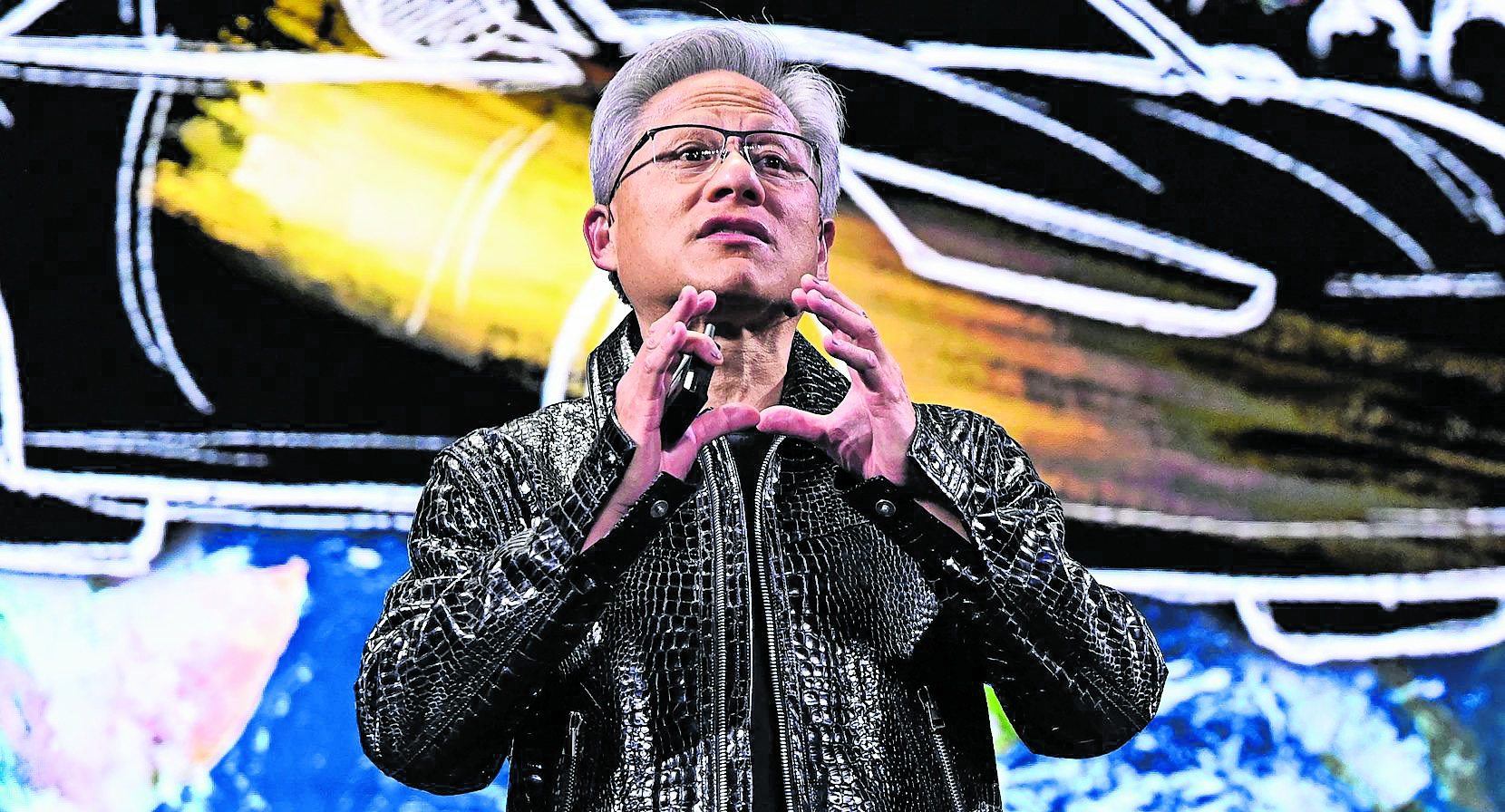
Jensen Huang delivers a speech in Las Vegas in January

From driverless cars to humanoid robots, there are very few technological pies that Jensen Huang, the chief executive and founder of Nvidia, does not have his fingers in.

The titan of the artificial intelligence industry made his fortune from the powerful processors (GPUs) which are enabling the AI revolution but this year in particular he has become involved in every corner of the technology — it is hard to find anything AI-related that Nvidia is not involved in.

Under Huang’s leadership, Nvidia has agreed major deals with an array of companies from OpenAI, the world’s most valuable frontier AI company, to Intel and Nokia.

Asked by The Times a few months ago how he felt about his powerful position, Huang said: “This is probably the most impactful technology of all time.

The ability to manufacture intelligence is quite an extraordinary thing. It’s a great privilege to be working in the company at the centre of that.”

Like the proverbial spider, Nvidia and Huang, are so much at the heart of the AI web that some have questioned whether the business is now too big to fail, so entangled is it with the entire AI machine, not to mention the stock market.

Together, the Magnificent Seven stocks, with Nvidia at the front of the pack, make up 35 per cent of the weighting of the S&P 500. This had led bears to warn about concentration risk in the hands of a small club of tech names.

If Nvidia crashed, it could lead to a hit to indices such as the S&P and the Nasdaq as well as to pension funds. The Bank of England and the International Monetary Fund are among those that have spoken out about the impact of a “sharp correction” to the megacap tech stocks, as a risk to financial stability.

Bulls argue that these companies are delivering real returns from their AI investments, as demonstrated by their soaring revenues.

Nvidia became the world’s most valuable company, for the first time, on June 18, 2024, when it overtook Microsoft.

This year, just when it seemed as though the share price could not get any higher, it smashed through a $5 trillion valuation in October.

Each quarter, Nvidia delivers forecast-beating results which seem to stick two fingers up to those who talk of bubbles.

“From our vantage point, we see something very different,” Huang said when asked about this during his most recent earnings call.

The company’s revenue for the three months to October jumped 62 per cent to $57 billion. It is expecting orders of more than $500 billion through 2026.

One outlet for the cash generated by this financial success is Nvidia’s venture capital arm NVentures, which stitches the company even more tightly into the AI ecosystem.

It has been on a tear this year, signing more than 50 deals with AI startups, focusing on areas from humanoid robots, with investments in Figure AI, to self-driving cars such as Nuro and Waabi, to infrastructure with Scale AI, CoreWeave and Lambda and enterprise AI companies including Cohere, Perplexity and Hippocratic AI.

British businesses have been big winners from Huang’s beneficence.

In the past year Nvidia backed some of Britain’s top AI companies including ElevenLabs, Wayve, PolyAI and Revolut as part of a round which valued the latter at $75 billion.

Huang also partnered with Nscale, a new infrastructure business, to deliver Britain’s version of “Stargate”, planning to deploy about 60,000 GPUs in the UK.

This rate of dealmaking and some of Nvidia’s larger investments, which include reciprocal arrangements where companies get backing from Nvidia and agree to buy its GPUs, have led to concerns in the market about “circularity”. It has raised comparisons with the “vector financing” of the dotcom boom.

Analysts at Morgan Stanley wrote a report puzzling over this, which included a now infamous diagram highlighting the messy and interconnected relationships between Silicon Valley’s AI businesses. It was referred to as resembling a “plate of spaghetti”.

One particular deal which Nvidia struck that raised these “spaghetti” fears was with OpenAI, which said it would buy millions of Nvidia’s AI processors from the end of next year, which could generate hundreds of billions of dollars in revenue for the chipmaker.

OpenAI is expected to pay Nvidia in cash for chips, and Nvidia could invest in OpenAI for non-controlling shares.

The first $10 billion of Nvidia’s investment will begin when the two companies reach a definitive agreement for OpenAI to buy its chips.

In another deal in December, Nvidia bought about $2 billion of shares in Synopsys, the chip-design software company, as part of a deep AI-tools partnership for chip design and “digital twins”, or virtual replicas of real objects.

Returning to the cacophony of concerns about a bubble: there is no doubt that Nvidia is throwing off cash, but there are worries that its customers may not be able to sustain this spending.

If they cannot, what does that mean for Nvidia and for demand for its products? As well as the centre of AI, Huang has been thrust into a central role in geopolitics in 2025.

When President Trump flew to Britain for a state visit, Huang was one of those by his side and chosen to take a seat at the (enormous) table in the banqueting hall at Windsor Castle with the King.

He has consistently pushed the importance of AI sovereignty, countries owning their AI infrastructure, and spent time with many world leaders including President Macron in France, where Huang is an investor in the European frontier AI company, Mistral.

Once again with Trump and alongside the billionaire Elon Musk, Huang spoke at the Investment Forum when the US signed a “Strategic Artificial Intelligence Partnership” with Saudi Arabia in November.

Musk and Huang announced a deal with Humain, a Saudi AI company, to build a 500MW data centre.

While Huang has cemented many new international deals in the past year, one important relationship has fractured: with China.

Nvidia’s chips are treated as strategic infrastructure and the US government looks closely at which Nvidia AI chips can be sold to China and under what conditions, precisely because they are seen as crucial to AI leadership and security.

Huang would like to keep the lucrative market in China open. Not least because the company is also in a race against Beijing’s homegrown AI ambitions.

The release of DeepSeek last January stunned the world, when the Chinese company produced a free AI assistant that purported to use lower-cost chips and less data than US rivals. As a result, Nvidia lost $590 million in value.

In a reprieve for the business, at the end of the year, Trump’s administration approved the sale of advanced Nvidia chips to China.

The company has also developed a software feature with location verification technology that shows what country its chips are operating in, Reuters has reported — a step that may continue to mollify the White House.

This has demonstrated that while Nvidia may have the market for AI chips sewn up for now, there are plenty of aggressors trying to take that crown.

Alphabet shares rose dramatically this year as its Gemini models got rave reviews, trained on its own processors, called TPUs. Amazon is also making its own versions called Trainium.

The traditional semiconductor businesses are racing ahead too. One sign of this is that OpenAI is diversifying its chips base away from Nvidia and has struck deals with AMD and Broadcom for compute power. It too is working on its own systems.

Then there are AI chip start-ups such as Groq, whose language processing unit claims to make running large language models cheaper, and Britain’s Graphcore, which was recently bought by Softbank, also the owner of the giant chip-architect, Arm.

Masayoshi Son, chief executive of Softbank and one of the world’s top tech investors, said that he wept when he sold his Nvidia shares this year. He had to cash out in order to make more investments.

Could others follow suit? Travelling around the world, delivering his message about the impact of AI in his trademark leather jacket, Huang seems unfazed by talk of bubbles, by the threat of rivals and the naysayers. The year ahead presents a litany of challengers, but he is up for the fight. 

Friday, December 26, 2025

AI25068 Blogspot to PDF. V01 261225

 Comprehensive Analysis of Digital Archival Methodologies for Google Blogspot Accounts: Systems, Protocols, and PDF Conversion Frameworks

The digital ecosystem of personal and professional publishing has historically prioritized accessibility and discoverability over permanence. For users of Google’s Blogger platform, colloquially known as Blogspot, the question of whether a blog account can be converted into a downloadable PDF is not merely a matter of technical convenience but a critical inquiry into digital legacy preservation. As of mid-2025, the technical landscape for achieving this conversion has been fundamentally restructured due to significant changes in Google’s internal data portability protocols. While the Blogger dashboard does not provide a single, native "Download as PDF" button, a sophisticated array of extraction, rendering, and synthesis methodologies allows for the creation of high-fidelity digital archives. This report examines the evolution of these systems, the mandatory integration of Google Takeout as the primary archival vector, and the diversified third-party ecosystem that bridges the gap between raw data and paginated document formats.  

The Paradigm Shift in Blogger Archival Infrastructure (2025)

The most significant development in the history of Blogspot data management occurred in the summer of 2025. Prior to this period, Blogger maintained an independent, localized backup system that allowed users to export their content—specifically posts, pages, and comments—as a singular, relatively compact XML file. However, effective July 1, 2025, Google transitioned Blogger entirely into the Google Takeout infrastructure. This move was not merely a cosmetic update but a fundamental re-engineering of how blog data is structured and retrieved for the purpose of archival and subsequent PDF conversion.  

Under the current regime, Google Takeout serves as the sole official method for backing up Blogger content. This integration offers several systemic advantages, such as unified backups of all blogs associated with a single Google account and the ability to schedule recurring, automated exports every two months for a year. Yet, this shift introduces substantial complexity for users seeking a simple PDF download. The "raw materials" provided by a Takeout archive—namely the feed.atom and theme-layouts.xml files—require secondary processing to reach a document-ready state. The implications of this change are profound for the archival workflow; users no longer handle a simple text-based XML file but must instead manage a comprehensive ZIP archive that may encompass gigabytes of data, including every image and video ever uploaded to the account.  

Comparative Infrastructure Analysis: Pre- and Post-2025 Archival Protocols

AI25067 What is OpenAI o1 ? V01 261225

 OpenAI o1” isn’t a replacement for an LLM—it’s a different way of using an LLM

The “o” stands for “omni” . 


Here’s the clean breakdown:


What an LLM is


An LLM (Large Language Model) is the underlying model itself.

Trained on massive text data

Predicts the next token based on probability

Examples: GPT-4, GPT-4o, Claude, LLaMA

Strengths:

Fluent language

Fast responses

Broad knowledge

Weakness:

Can hallucinate

Often shallow or brittle on multi-step reasoning


Think of an LLM as a very powerful autocomplete engine.


What OpenAI o1 is


o1 is a reasoning-focused model built on top of LLM technology, optimized to think before answering.


Key differences:


1. Explicit reasoning step


o1 internally:

Breaks problems into steps

Evaluates intermediate reasoning

Self-checks before producing an answer


This is different from standard LLMs, which usually respond immediately.


2. Optimized for hard problems


o1 is especially strong at:

Math

Logic puzzles

Coding

Scientific reasoning

Multi-step planning


Standard LLMs often fail silently on these.


3. Slower but more reliable

o1 trades speed for correctness

It uses more compute per answer

Fewer confident-but-wrong responses


4. Different training objective


Instead of only optimizing for:


“What sounds like a good answer?”


o1 is optimized for:


“What is the correct answer after reasoning?”


Simple analogy

LLM = fast, articulate conversationalist

o1 = careful problem-solver who pauses to think


Both use language modeling, but with very different behavior.


When to use each


Task Better choice

Casual chat Standard LLM

Writing & creativity Standard LLM

Math / logic o1

Complex coding o1

High-stakes reasoning o1


One-sentence summary


o1 is still an LLM, but it’s trained and deployed to reason first rather than respond first.


If you want, I can also explain how this compares to chain-of-thought, tool use, or agentic models.

Sunday, December 21, 2025

AI25066 Data Labelling Industry V01 211225

 The army of fact-checkers marking AI’s homework

A 38-year-old billionaire has hired a million of ‘the smartest people in the world’ to train digital brains. But is this pool of talent doing itself out of a job?

DANNY FORTSON - San Francisco

Surge AI has hired what it calls the best and the brightest to educate AI 

To visit MathOverflow, an online forum for professional mathematicians, is to step into another world. Ever pondered the “quantization of symplectic vector space and choice of lagrangian subspaces”? This is your place. If you’re a fan of “polyhedral complexes and shellings?”

Look no further.

For most, this might very well be the last corner of the internet in which they would choose to spend time. Yet for Edwin Chen, it’s a happy hunting ground.

The 38-year-old billionaire founder of Surge AI, a five-year-old New York start-up, has recruited more than a million of what he claims are the brightest minds on the planet, to train, to probe and to coach the world’s artificial intelligence systems into becoming ever clever.

“We basically teach AI models, and then we measure how well they’re learn- ing. We do that by bringing together the smartest people in the world,” Chen explained. “We actually have what I believe is the largest group of PhD experts in the world on a platform, teaching these models.”

People such as Oliveira Santos, 25, who spends her days crafting mind-bendingly difficult “frontier math” equations to throw at AI systems. Her first one ran to more than 40 pages. “I was planning to follow an academia kind of path where I guess my final goal was to be a professor,” she explained. “But since AI came to be, I found, ‘OK, no. I actually want to work in the industry. This way I feel I can make much more of an impact on the world.’”

"Some very well educated people are being treated worse than a fast-food worker

Much of the conversation about the AI revolution has focused on the likes of OpenAI and Google, the companies designing these powerful systems, or on the data centres and power plants being built to power them.

But there is a third leg of the stool: the millions of contractors who are, every day, all day, toiling far from the bright lights of the AI revolution, taking an hourly wage to feed the all-important data to these systems.

This unseen army, working in global locations from Lagos and London to Manila, are engaged in what amounts to a huge transfer of knowledge from humans to digital brains — one that, if Silicon Valley is to be believed, will put up to half of white-collar workers out of a job.

Chen, a former AI researcher at Meta, Twitter and YouTube, has emerged as one of the key players at the heart of this booming “data labelling” industry. He has plenty of competition. Meta paid $14 billion (£10.5 billion) for half of Scale AI, Surge’s rival, while Mercor, a twoyear-old start-up, raised $350 million from investors who valued the company at $10 billion.

Data-labelling companies may all get dropped into the same category, but they often do wildly different things. Some operate at the lower end, paying rock-bottom wages to people in the developing world to do the grunt work of labelling bits of content — this is a cat, this is a joke — so that AI can “train” on the data. Others correct the AI tools when they spit out bad answers.

Surge AI’s army specialises in what is known as “reinforcement learning through human feedback” (RLHF), in which highly qualified professionals push at the outer limits of what AI systems can handle. The company pays anywhere from $20 an hour to as much as $500, depending on the labeller’s particular skills. Most of its workforce, Surge added, live in English-speaking countries such as North America and Europe.

Beyond the numbers, however, a labour fight is brewing over whether the contractors used by Surge AI and its ilk should be treated as employees — and thus have better pay and conditions.

Glenn Danas, an attorney at the law firm Clarkson in Malibu, California, has sued Surge, Mercor and Scale AI over working conditions and wage theft.

Danas said: “In this industry, one of the unique aspects is that there are some people who are very well educated and they are being treated worse than a fastfood worker.”

His suit against Surge alleges a range of alleged infractions, including requiring unpaid training, ending projects without warning, not providing paid meal and break times, and not compensating for overtime. Surge said the suit was “without merit” and has entered into arbitration on the case.

“The problem is, we’re sort of allowing these companies to get at skills that should be very highly compensated, super cheaply,” Danas said. “The consequence will be that you’ve just sort of aided creating this thing that then won’t need you any more, and it really just didn’t pay what it should have.”

Indeed, this work begs that very question: are participants not speeding their own demise tomorrow in exchange for some cash today? Oliveira Santos doesn’t look at it that way. “This is a big question that probably everyone in the field is asking themselves,” she said. She reckons, however, that AI will evolve into something of a thought partner, handling the boring parts of a job while assisting on the more knotty problems.

“I’m actually going to need AI to explore all these ideas that I didn’t have the time to explore before,” said Santos.

So just where is this frantic AI race leading?

Chen at Surge AI is very clear: artificial general intelligence (AGI). It is a nebulous term but can be broadly understood to describe systems that are better than the sum of all humans at any cognitive work — a notion that not long ago was dismissed as the stuff of science fiction.

“We’re trying to create AGI,” Chen explained. “Not AGI that replaces us, but that makes us better in some sense, helps us explore the galaxy, helps us cure cancer, so that we can do even more.”

He started Surge in 2020 after spotting a problem that came up time and again during his years working inside the Big Tech machine. No matter what a company tried to optimise its technology for, be it clicks or re-tweets or comments or likes, the algorithms would always end up in the same place — optimising for lowquality clickbait: divisive posts, listicles, misinformation.

AGI would never get built, he surmised, on cat videos and conspiracy theories.

So using a few million dollars that he had amassed from his time in Big Tech, Chen launched Surge, building an automated system that scoured the globe for astrophysicists and poets and chemists, as well as intricate systems to check their work.

“We built all these algorithms to find the best people, and we have also built all these, kind of, content moderation-type systems to remove the bad people. Because we have invested so much in measurement, we can actually measure whether or not the quality is improving,” he said.

“We were basically founded because we saw that the biggest problem in reaching AGI was going to be the data.”

The company last year pulled in $1.2 billion in sales, thanks largely to the premium it charges for its services relative to rivals less focused on “frontier” data. Nick Heiner, Surge’s head of reinforcement learning, used an analogy with golf to explain what Surge does.

To get better at golf, he explained, you could either spend, say, a million hours practising on a mini golf course, or a million hours on a professional course like California’s Pebble Beach with a coach at your elbow giving you pointers. Surge sees its work as the latter. The company is still private but is reported to be worth $30 billion, which means that Chen, who retains a 60 per cent stake, is on paper worth $18 billion.

What worries him? By who and how AI systems are being built. Chen deliberately left Silicon Valley and started his company in New York because he wanted to get out of the west coast tech “monoculture” where start-ups focus on “engagement tricks” rather than building tools that are genuinely useful.

“It’s a very ‘get rich quick’ mindset,” he said. “I worry about that because if Silicon Valley is the epicentre of AGI, and this is the mindset of the people who are building it, it’s like, ‘How does that shape your motives? How does it shape your goals?’ ”

We will soon find out.

$14bn Sum Meta paid for half of Scale AI, Surge’s rival, this summer 

$10bn Value put on Mercor, a two-year-old start-up, after it raised $350 million

Friday, December 19, 2025

AI25065 AI Code Generation - Lovable V01 191225

 Investors get good vibes from Lovable


Katie Prescott - Technology Business Editor

The Swedish AI company Lovable has raised $330 million, valuing the business at $6.6 billion.

This latest funding round, its Series B, included the venture arms of Nvidia, Salesforce and Databricks and was coled by CapitalG and Menlo Ventures.

It shows the meteoric rise of one of Europe’s leading start-ups and marks a huge jump since its last valuation of $1.8 billion in July, when it raised $200 million, led by Accel.

The tech business, which only launched its product in November last year, allows users to describe the app or website they want and Lovable will generate it. Known as “vibe coding”, it has caught the zeitgeist to such an extent, that it was the Collins Dictionary’s word of the year, defined as the use of artificial intelligence to turn natural language into computer code.

Anton Osika, chief executive, and Fabian Hedin founded Lovable in 2023 to “democratise software creation for the 99 per cent”, meaning that everyone could build apps, not just the 1 per cent who know how to code.

Osika gave examples of users including a nurse at one of the world’s largest healthcare organisations who built an app to show patient journeys which is now included with every invoice sent out.

“The new builders span every age group, socioeconomic bracket, and geography. Some sit in dorm rooms, others sit in board rooms,” he said.

Lovable now employs 120 people and is opening offices in Boston and San Francisco. Early backers included fellow European entrepreneurs Sebastian Siemiatkowski, the chief executive of Klarna, and Nik Storonsky, chief executive of Revolut.

Lovable claims to have $200 million annual recurring revenue, double its July figure, 5 million daily users and half a billion visits to sites built by its software in the past six months.

Laela Sturdy, of CapitalG said: “Lovable has done something rare: built a product that enterprises and founders both love. The demand we’re seeing from Fortune 500 companies signals a fundamental shift in how software gets built”.

Thursday, December 11, 2025

AI25064 AI Slop V01 111225

 Tale of cats v tigers that should worry us all

AI slop can offer a welcome diversion but the tidal wave of online disinformation is designed to detach us from reality

Hugo Rifkind @hugorifkind

Normally, these days, when Instagram wants to hook me in it offers me DIY tips and hot brunettes in slinky dresses. Not at the same time, you understand. That would be impractical. Still, the algorithm on this social media network has peered deep into my probably quite textbook middle-aged soul and has decided that this is the way.

A female friend of a similar age, meanwhile, mainly gets lumberjacks. Each one will first cleave a log with his axe. So far, so lumberjack vanilla. Then, though, they’ll get down on their hands and knees, stick their muscular, lumberjack fingers into the, um, crevice and rip the log apart. She says she’s seen hundreds like this. Right to the end.

Look, I’m not a mug. I see what’s going on here. Get thee behind me, hot brunette Satans and ingenious ways of fitting shelving; I see your game. Recently, though, a video caught me off guard. This one, shot as if it were grainy CCTV, showed a tiger entering a backyard where a dog was sleeping. Tiger attacks dog, dog prepares to die. Then, from off-screen, appears a high-velocity house cat, which flies at the tiger’s face and causes it to flee. “Brave kitty,” I thought, quite moved.

Then I kept seeing more of them. Different videos, different backyards, different big cats, same scenario. “How remarkable,” I found myself thinking, “that this is such a commonplace occurrence!” Before realising, of course, that it was AI. Suddenly, everything is. Probably even the lumberjacks. Out there on social media, quite abruptly, more things are AI than are not.

This week, speaking to mark the centenary of the Treaty of Locarno, the foreign secretary, Yvette Cooper, warned of the threat to our democracy posed by AI misinformation, chiefly from Russia. Seeking examples, she was spoilt for choice. Last month, as Russian forces laid siege to Pokrovsk in eastern Ukraine, social media users found their feeds flooded with videos of Ukrainian soldiers weeping and surrendering. All fake. Last year, also, just before Volodymyr Zelensky’s visit to South Africa, fake news videos circulated claiming he’d bought a platinum mine.

This is disinformation in its purest form. And yet, in highlighting it, Cooper was met, as ever, with a sort of shrug. “This isn’t about me,” people just seem to think. “It’s about other people. I would never be fooled.”

In fact, it’s not so simple. Last week in The New York Times, a report made two key observations. The first was that AI videos have swiftly become ubiquitous and that none of the tech-led safeguards against them seem to be working. That deluge people used to warn about? It’s here.

The second point was that even when you do tell people they’re watching AI, it doesn’t make much difference. The paper cited a supposed news report circulated on TikTok during the recent US shutdown, in which a woman, who didn’t exist, boasted of selling food stamps to an interviewer, who didn’t exist either. Visibly flagged as fake, it still attracted thousands of comments from people who didn’t seem to care.

It staggers me how many people manage not to care about this

Probably that one wasn’t Putin’s fault. For the record, I’m not suggesting he’s sending me cat videos either. All sorts of people are doing this stuff. Last month, for reasons best known to itself, Elon Musk’s X platform started revealing location data for all accounts, leading to a flood of hardcore Maga activists suddenly being exposed as posting from Iran, or Nigeria, or India.

Most, rather than being state-sponsored, will have been doing it to make money through amassing audiences, as was the case even back in 2016 when lots of Trump-favouring Facebook fake news was shown to have come from places like Moldova and Macedonia. Yet it should remind us, all the same, that the political space in which we live is not a merely organic one, shaped only by real people, who think real things. It is manipulated, chivvied, faked and steered, a thousand times a day.

It staggers me, endlessly, how many people manage not to care about any of this. Not even now that it has moved from an alarmed hypothesis shared by internet Cassandras (such as me) and is now verifiable fact.

“I’m not on these platforms,” people still say. “They’re for mugs.” But your friends are and your families are. So are your politicians and the journalists who cover them, and both of these groups have learnt what goes viral, what spreads, what attracts worship and adulation, what attracts hatred and contempt. You, too, exist in this ecosystem, whether you want to or not.

Disinformation doesn’t exist only to fool you. It also exists to bore you, to confuse you, to befuddle you, to make you doubt yourself and everyone else. It exists to detach you from reality. And so we now live in a world in which, after working hard for well over a decade to destabilise western politics, the Kremlin gets to say that the latest US national security strategy is “largely consistent with our vision”. And in which the US right can say Europe is a violent hellscape, and in which a decent number of British pundits will affect to agree with them, no matter that they actually live here and can look out of a window.

Look, I get it. Most AI slop isn’t even political. Those brunettes are really hot and so are those lumberjacks. Those kitties could not be more brave. I also get the note of hysteria that seems to be creeping in towards the end of this column.

Believe me, I’m working hard to rein it in. But does nobody care how all of this has happened? Is nobody even interested? With the tools now at our disposal, God knows, we’d have been more than capable of going at least this mad all by ourselves. But we haven’t done it by ourselves, have we? How long until we wake the hell up?


AI26019 Copyright and AI V01 100326

  Creative types have the upper hand in AI copyright fight Katie Prescott Kanishka Narayan is the minister for AI Next image  › ‘‘ Pimli-cod...