Copyright The Times
Somewhere in the skies over the western Russian city of Pskov, four combat jets begin a dogfight.
The two aircraft on the red team, flown by professional fighter pilots at the controls of a pair of simulators, twist and turn at hairpin angles in an effort to elude their blue pursuers.
One flyer dodges an air-to-air missile and squeezes off a retaliatory shot. Yet red team is fighting a losing battle: in the space of five minutes first one simulator screen fills with flames as the jet is struck, then the other.
The victor is an artificial intelligence (AI) algorithm that its developers say has picked up a career’s worth of aerial combat training in hours.
Helsing, a German-British start-up that is emerging as a prodigy of the European defence technology sector, is wiring the system into what it hopes will become the West’s first AI-guided uncrewed fighter jet.
Thomas Enders, a former head of the conglomerate Airbus who sits on Helsing’s board, said: “We’ve seen the results.
If you feed this thing with data for a weekend, you can produce a pilot with [the equivalent of] a lifetime’s experience or more. It’s a true revolution.”
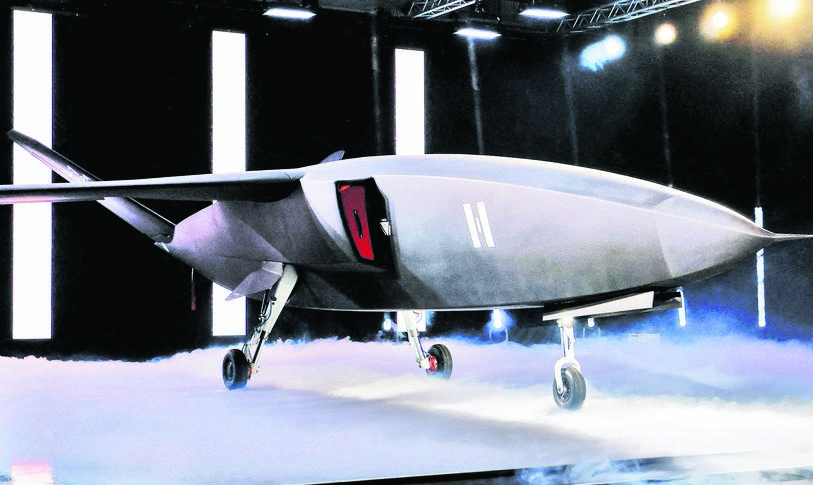
The CA-1 Europa uncrewed aircraft concept, unveiled yesterday in Bavaria, is designed to be cheap enough to mob enemy targets in swarms without risking the lives of human pilots.
The idea is to combine the expendability of drones with the speed and manoeuvrability of “loyal wingmen” — the semi-autonomous planes that will accompany the next generation of jet fighters such as the Boeing F-47 and the Tempest, a joint British-Italian-Japanese design.
It is Europe’s leading entry in a technological race. Analysts have said China is working on similar capabilities, while the first American loyal wingman-type “combat collaborative aircraft” may be put through initial test flights next month.
The urgency has been underlined by the repeated Russian incursions into Polish, Romanian, Estonian and Danish airspace over the past three weeks, at a time when Europeans are growing ever warier of dependence on American military hardware.
Enders said: “The nice, rules-based international order we Germans love so much is largely in ruins. Whatever pirouettes the president [Trump] turns these days ... what he is saying is: ‘Get on with your stuff on your own.’ He’s distancing himself from Europe. It could powerfully whet Putin’s appetite.
“Right now we are having an occasionally timid debate in our country: ‘Oh God, now we have to very rapidly rearm our armed forces — we’re going to have to buy American gear ... because we can’t buy any of our own stuff.’ Nothing could be more wrong.”
The CA-1 Europa design, revealed at the Grob Aircraft factory near Tussenhausen in southern Germany, is 11m long, has a 10m wingspan and weighs four tonnes. It will carry a variety of systems for reconnaissance, electronic warfare and strike missions.
Helsing is coy about the other details. Its top speed is “high subsonic”, meaning up to 760mph — or a little less than half that of an F-35. Torsten Reil, the firm’s joint chief executive, said it would sell for “a fraction” of the $70 million to $100 million cost of a fighter jet but declined to be drawn any further.
Gundbert Scherf, another founder, said the jet was based on the premise that Nato could not afford to get sucked into a war of attrition, like that between Russia and Ukraine. He said the alliance would have to decide the outcome of any conflict within two weeks.
“Our strength lies in asymmetry,” Scherf added. “A swarm can overwhelm the enemy through sheer numerical dominance and complex, co-ordinated manoeuvres.”
The first flight is not likely until 2027. Helsing, however, has already demonstrated proof of concept. The firm predicts that air forces will start using uncrewed systems within five years.
Under a deal signed a fortnight ago in London with the Danish defence software company Systematica, Helsing’s swarms will be integrated into the computer systems commanders currently use to control land, sea and air forces.
Reil insisted that decisions on which targets the AI-steered aircraft struck would always be taken with “a human in the loop”.



No comments:
Post a Comment