Dousing fire of energy Armageddon
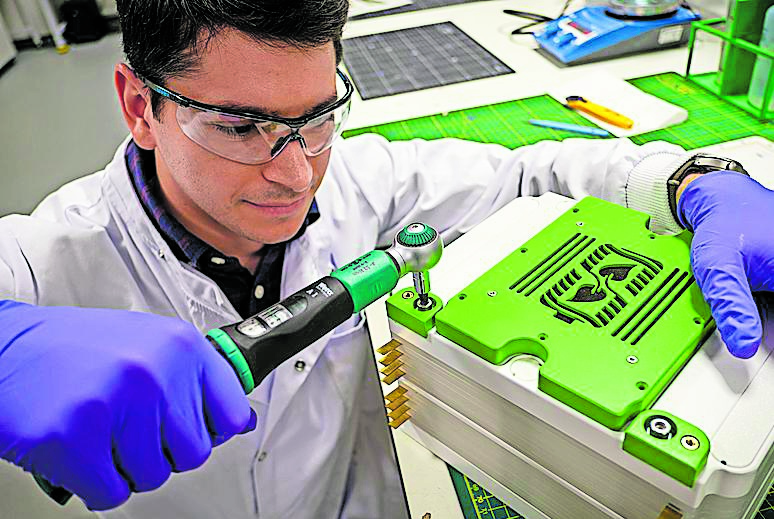
‘How do you know when you have a tiger by the tail?” wonders Jane Hunter, whose surname does not give away her profession. She is in fact the new chief executive of a cutting edge battery technology business called Superdielectrics, which is hidden on a science park on a country estate south of Cambridge.
Its battery cells are 52 per cent water-based yet they perform in line with lithium-ion ones, are cheaper — and don’t catch fire.
The tiger in question is the demand from the two main markets Superdielectrics is looking to serve: safe, low-cost home energy storage and energy-hungry AI data centres. The latter in particular are spending heavily.
McKinsey, the consultancy, estimates that $7.9 trillion of capital investment will be in AI data centres between now and 2030.
The power demands of the servers sitting within AI data centres, training generative AI models and answering the world’s prompts, are wreaking havoc with national grid systems. When an AI bot is asked a question, it leads to a millisecond surge in power consumption, which then subsides and then surges again.
The wild oscillations — “megawatt hits” some 15 times larger from peak to trough than what the grid is used to from existing cloud data centres — are pushing ageing systems beyond their limits. Data centre operators are being warned that they need to fix the issue, and quickly. The blackout earlier this year in Spain will not be the last, it is feared.
“This is like Armageddon for the grid,” says Shelley Brown, chief technology officer at Superdielectrics.
“This is a technology moment that we saw with the start of the electrification of cars. This interaction between data centres and the grid is entirely new, it hasn’t been seen before.”
One option is to use traditional lead-acid or lithium-ion batteries to manage the volatile electricity demand.
But the lithium ion-batteries don’t react well to being emptied and recharged quickly. Sometimes, under stress, they can catch fire. Doing so in a $15 billion data centre is not ideal.
Superdielectrics’ patented waterbased membranes could be a solution.
They are based on polymer science developed at the University of Surrey, originally from exploring breakthroughs in contact lenses. The carefully structured aqueous membrane sits between a specially designed cathode and anode in an electrolyte liquid containing zinc.
The electrochemical reaction that takes place at the boundary between the electrodes and solution is turned quickly into electrical energy, which is then dispensed.
“The way the zinc interacts with the membrane is pretty special. We are getting performance from it that you won’t get from other systems,” says Brown. No rare earth mineral nasties are needed, ticking the sovereign capability and affordability box.
While less energy-dense than lithium or sodium-ion alternatives, something that determines storage capacity and so is vital for extending the range of electric vehicles, Superdielectrics says its battery cells beat its rivals on cost and safety; and in the case of supercapacitors — used to address some of the power surges in AI data centres — they can also store more energy.
Batteries make up roughly 10 per cent of the cost of a $15 billion data centre, making it a highly attractive market. When fully tested, several thousand Superdielectrics battery cells could act as such a power unit, supplying the servers as they need power and smoothing out the demand for that power from the grid.
Hunter says its Faraday 2 battery pack, launched in July and capable of storing surplus renewable energy efficiently, is at stage six in terms of technical readiness. The next pack design will be “smaller, lighter and faster”. Stage ten is the commercial equivalent of national treasure status.
“It will be another couple of years down the development path.” The energy giant Eon recognised the technology’s potential use for home energy storage and management when it became a partner in April.
Hunter has moved halfway around the world, from Brisbane, to take up the role, leaving Australia’s weather and her Tesla behind but bringing her daughter, who has started at sixth form. “I don’t have any reservations about coming to the UK, and Cambridge is such a beautiful part of the UK,” she says.
Hunter previously led Boeing’s development wing, called Phantom Works, as its chief operating officer, developing the 38ft Ghost Bat stealth drone that should see deployment by the Royal Australian Air Force.
She then had a four-year stint as chief executive of the liquid-cooled electric vehicle fast-charging firm Tritium. In 2021 she led its listing on the Nasdaq stock exchange in New York via a special purpose acquisition company (Spac), in a deal that valued Tritium at $1.2 billion, but like many such deals the experience didn’t end well. The company went into administration last year, before its assets were snapped up by the Indian charging giant Exicom.
Such war wounds may help Superdielectrics when it comes to scale. “I am excited by complex, disruptive tech that I think can change the world,” says Hunter. “With batteries we are at an inflection point. Lithium-ion was developed to look after transport, but there are other markets like data centres and AI where a transport battery is not performance optimised.
“Having a water-based battery would be ideal for sustainability, flammability and performance. This is a time when we are going to see new technology. We think what Superdieletrics has is real and we can take it to market.”
Jim Heathcote, Don Highgate and Nigel Spence founded Superdielectrics in 2013 and Heathcote ran it until this summer. Highgate was also the founder of the hydrogen electrolysis specialist ITM Power; Heathcote was a former chief executive of the listed company.
Superdielectrics raised £17.2 million in 2020 and moved into its current base in Cambridgeshire. The company has 30 staff, including 24 in the lab, 14 of whom are PhDs, with a zinc battery specialist just recruited from Egypt.
Hunter is still immersing herself in the east of England’s entrepreneurial scene and sees some similarities with Australia, which also faces challenges around the availability of capital for early stage companies.
“The UK is building that, but you have to support companies through the growth phase,” she says. Brown credits the positive impact of the government’s Faraday Battery Challenge, a £610 million initiative that ran from 2017 to this year, led by the agency Innovate UK. “It was visionary. They invested into PhDs who were doing battery projects that provide that pipeline of talent that is making it easier for us to be competitive on a world stage.”
UKBIC, a £200 million national manufacturing battery development facility in Coventry that opened in 2021, has also been a vital asset, enabling battery technologies to be tested quickly. “There is an ecosystem for battery development that is world-class ... That has been ten years in the making,” says Brown.
Hunter has encountered some cultural differences. She is clear that Superdielectrics is about to embark on a five-year sprint, which will require some long days. Not long into the role, the office lights automatically went off at 7pm and she found herself sitting at her computer using her phone light to muddle through. The office lights were on a timer that she couldn’t override.
Environmentally friendly, yes, but perhaps not commercially friendly. The settings have since been changed. After all, keeping the lights on is the primary job of every chief executive.
10% Share of the cost taken up by batteries in a modern AI data centre



No comments:
Post a Comment