Deadly AI sea drones take fight to Putin’s navy
The naval drones cut white wakes in the dark as they sped across the Black Sea towards their targets. One group, Ukrainian Magura drones, moved south. There they were to wait, bobbing in the waves, until the order came to strike the Russian coast.
Before they could attack, the Black Sea Legion, a special operations detachment within the Ferrata unit of Ukraine’s military intelligence, HUR, would need to blind the Russians. Their mission that night of September 21 was to take out a powerful radar system that could scan far across the water. By doing so, they would open up Russia’s coastline to attack by sea.
Since 2023, Ukrainian uncrewed surface vessels have harassed Russia’s Black Sea fleet, sinking as many as 15 warships, and forcing others to take refuge in ports along the Russian coast.
No longer able to sweep the waves with shipborne radar, the Russians installed radio location systems and electronic warfare devices on gas drilling platforms halfway between occupied Crimea and the Ukrainian mainland and garrisoned them with marines.
“There were several Russian gas platforms where electronic warfare and radar systems were located. Our goal was to inflict damage on the platforms, inflict damage on the personnel, and neutralise the radar systems,” said “Nine”, the legion’s commander.
The sea drones that helped destroy a third of Russia’s Black Sea fleet — Maguras — are fast kamikaze boats, remotely operated via satellite link. Now, Ukraine has moved onto the next generation of naval drone warfare. Nine and his team operate a fleet of Katran drones — advanced, multi-purpose systems packed with sensors and equipped with artificial intelligence targeting software.
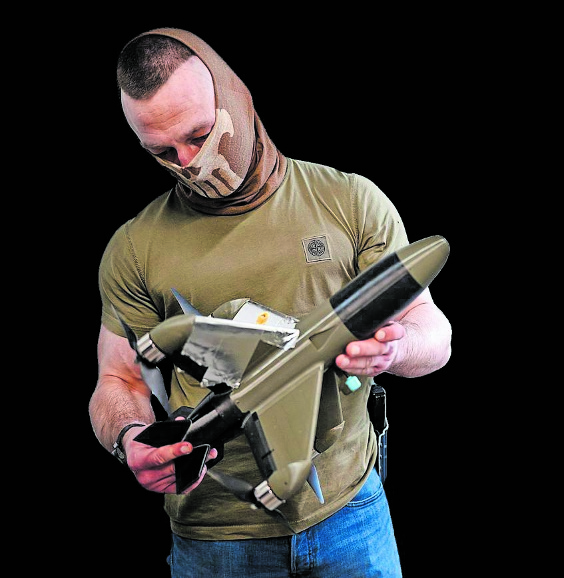
Acting like miniature aircraft carriers, they carry remote-operated drones launched by catapult and firstperson-view suicide drones that take off from springloaded trapdoors. The newest version, the Katran Venom, can launch four torpedoes, has a front-facing M134 mini-gun for striking seaborne targets, and a remote-operated turret with a Browning M1 machinegun for air defence.
Nine’s operation is the result of his special forces outfit and a tech start-up working hand in glove. At headquarters, a series of 3D printers hum away as they produce new components. Engineers test 360-degree camera mounts and train AI software to visually identify targets, informed by propaganda footage of naval craft broadcast on state TV from the Russian republic of Dagestan. Red boxes on the screen flash over military vessels, yellow over support craft, green over civilian craft, or white when the AI is undecided.
Operators use virtual reality goggles with a 360-degree field of vision around their craft, accompanied by a display that tracks speed, power level and munitions status. By selecting each weapon, they can arm it, and launch. Calculating range, environment and other factors, the artificial intelligence advises on the best method of attack and whether the airborne drones are likely to reach their targets. All this is controlled while sitting on a fold up deck chair that fits in a large backpack and can be deployed anywhere.
On September 21, a pair of Katrans moved ahead of the Maguras towards the gas platforms. Between them they carried nine FPV (first-person view) drones and four aircraft-type drones. Slung under each was an additional weapon — a submersible suicide drone, essentially a long-range smart torpedo, each with an 80kg explosive warhead.
The Katrans also launched their torpedo drones 50km from the rigs, then raced away as the jets descended to intercept the decoy. Completing a 100km loop, they came at the gas rigs from the opposite direction to the torpedo drones, which were idling underwater 15km away from the rigs as they waited for the Katrans to get into position.
“The first guided unmanned underwater torpedo struck the platform’s support, and in the open space above, the soldiers who had abruptly awakened began to run out,” said Nine, describing how the FPVs had hunted Russian marines scrambling around the burning rig. “Then the second torpedo hit. The radar systems we neutralised with aircraft-type drones.”
Meanwhile, the Maguras moved through the corridor opened up by the Katrans and swept around Crimea towards the Russian port of Novorossiysk, which they reached the next morning. Ukrainian attacks on Novorossiysk continue.



No comments:
Post a Comment